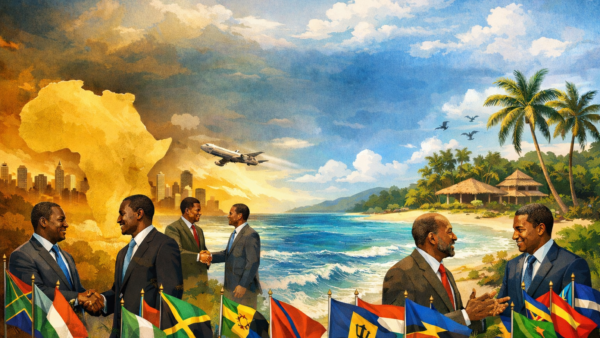


On September 7th, 2021, the African Union (AU) and the Caribbean Community (CARICOM) sought to strengthen their alliance by way of Summitry, thereby producing the first-ever AU–CARICOM Summit. This summital marriage was not by any stretch the first effort in the way of co-operation between these two historically linked regional groups yet it served, for many, one of the brightest auspices for the realization of a more robust cooperation between two regions whose partnership has the potential to capture, encompassingly, the ethos of South-South Cooperation (SSC). However, auspices are members of one set, and the realization, the member of another. This distinction is particularly evident in the manifestation of AU-CARICOM relations. Their intercourse – the AU and CARICOM – has produced very little in the way of mutual development. In view of this fact, this Chapter will seek to investigate the realities of manifestation of the AU-CARICOM dynamic by first establishing the most authoritative background for its exploration; a quadrivium, with its parts the following:
- Africa and the Caribbean’s historical linkages: The Pan-African Vantage
- The 1955 Bandung Conference
- 1978 The Buenos Aires Plan of Action (BAPA); and
- The Nairobi Conference
This quadrivium will demonstrate, through a concise historical overview of the emergence of continental Pan-Africanism, the undeniable and striking historical and typological connections that exist between Africa and the Caribbean, reinforcing promulgations that they are most suited to co-operation and alliance. Additionally, the quadrivium will pinpoint the introduction of South-South Cooperation into the global development cooperation discourse, laying the groundwork for comprehension of why Africa and the Caribbean, through the African Union and the CARICOM, are so innately and intrinsically suited to the “South-South” brand of development cooperation.
Africa and the Caribbean’s Historical Linkages: The Pan-African Vantage
It can be posited that the Transatlantic Slave Trade facilitated one of the largest dispersions of people across the globe. Countless African men, women, and children were involuntarily transported to North America, South America, and the Caribbean, where they were forcibly compelled to labor on plantations owned by European colonizers (Lovejoy, 2011). According to David Lambert (2017), Caribbean plantations alone were the destination for approximately five million enslaved Africans, effectively transforming the Caribbean into a new geographical domicile for Africans.
The newly enslaved, in addition to being introduced to new geographical quarters, were denied ownership of the most fundamental aspects of their identity:their names, the privilege to communicate in their native languages, their religious beliefs, their traditional dances, and other elements of their culture. Nevertheless, against all odds, the buried and often trampled rendering of Africans as an intelligent, dignified, resourceful people of inventive capabilities would rise again on these Caribbean plantations.
The enslaved began questioning everything they had been informed about themselves: they questioned narratives and caricatures that positioned them as sub-par, weak, and lacking in cunning, and in contrarianism – though often suppressed and stifled – they began to view their African-ness as a pathway to liberation. These enslaved men and women discovered methods to utilize their culture, religion, and languages to rail against the establishment: they used their hairstyles to provide directions to safe houses for those who were courageous enough to illicitly flee plantations, they harnessed their spirituality to manipulate a European etiological perspective not unlike their own – where death, disease, and misfortune could be traced to the supernatural – and in so doing asserted a form of power, instilling fear in their enslavers. They utilized their traditional medicines and herbs to poison infants whom they did not wish to endure a life of enslavement, and as they grew in confidence, they would burn property and eventually lead full-scale revolts (Windell, 2020). Their rising confidence paid off.
On January 1st, 1804, via the portals of revolution, the French Caribbean colony of Haiti attained territorial autonomy, becoming the world’s first independent black nation, validating and fortifying black belief that men and women of African descent were capable of forcing the relinquishment of imperial rule wherever they called home (Lundahl, 1985). By the 1850s, the slave trade and slavery had been abolished in Caribbean territories colonized by the British, Spanish, and French. Some of the enslaved were freed as per the edicts of emancipation; others were able to rally together to purchase their freedom through manumission, while others chose to remain on the plantations (Green, 1991; Beckles & Shepherd, 1996). Nevertheless, it is to be noted that these abolitions did not mean ease for the men and women of African descent who lived on these Caribbean territories; these imperial quarters. Colonialists still sought to bind them through other means. They wielded their authority in governance to exclude the formerly enslaved from opportunities and institutions that fostered progress. Restrictions were imposed on their access to specific educational establishments, professional fields, and essential social services, as well as safety nets (Campbell, 1980; Laurence, 1980; Beckles & Shepherd, 1996). Furthermore, their attire, languages, and cultural practices were stigmatized as indicators of impoverishment and uncivilized behavior, and in certain cases, even criminalized. However, this was only for a time, because Africa would once again rise, this time in the form of Pan-Africanism.
Seeking to counter pervasive exaltation of all that was colonial and pervasive degradation of all that was African or black, individuals such as Marcus Garvey, a native of Jamaica, as well as Henry Sylvester Williams and George Padmore, both natives of Trinidad, fostered movements that inspired men and women of African descent, often subjects of indignity of the grossest persuasions, to look upon themselves proudly and to carry themselves as descendants of kings and queens (Teelucksingh, 2013). Through the work of the aforementioned individuals and many more, peoples of African descent were consistently exposed to messages of black self-determination intertwined with ideologies of African nationhood and were reminded that they were better together than divided; that they had the means and the ability to attain wealth and prosperity as a race, even more so if they adopted a form of separatism to forge as one racial economic and social faction (Brooks, 1996).
In 1900, Henry Sylvestre Williams coined a term that would umbrella all movements that promote the solidarity, unity, and collaboration of people of African descent, both on the African continent and in the diaspora: Pan-Africanism. By then the messages and ethos of Pan-Africanism had escaped Caribbean shores, making entry into the United States and the United Kingdom, awaiting the arrival of one Kwame Nkrumah who would serve to facilitate its entry into the African continent (Brooks, 1996; Teelucksingh, 2013).
Kwame Nkrumah, a distinguished proponent of Pan-Africanism, became acquainted with the principles and ideology of Pan-Africanism during his academic pursuits in the United States and the United Kingdom. Nkrumah left Ghana (then the Gold Coast) in 1935 to study in the United States. He attended Lincoln University in Pennsylvania, where he achieved a Bachelor’s degree in 1939 and a Bachelor of Theology in 1942. He then went on to study at the University of Pennsylvania, earning a Master’s degree in Education and Philosophy in 1942 and 1943, respectively. It was during his time in the United States, that Nkrumah was introduced to the writings of intellectuals of African descent like W.E.B. Du Bois and Marcus Garvey, both of whom had strong Pan-Africanist ideologies (Geiss, 1974; Esedebe, 1994). He also joined and became an active participant in the African Students Association of America and Canada. Nkrumah’s dabblings with Pan-Africanism would continue even after he left the United States in 1945, moving to the United Kingdom to continue his studies at the London School of Economics. While in London, Nkrumah became deeply involved in Pan-Africanist activities. He participated in the Fifth Pan-African Congress held in Manchester in October 1945, where he met influential Pan-Africanists like George Padmore and Ras Makonnen.
One only has to consider Nkrumah’s crowning moments as champion of African Unification to recognize that his encounter with the message of Pan-Africanism underwent conversion to be reborn as embrassement. Nkrumah’s embrace of Pan-Africanism would lead him to fashion Willams’ and Garvey’s refrains of a united, powerful black [diasporan] nation to suit and uplift a then-colonized Africa. Consequently, in 1957, under his leadership, Ghana became the first tropical African nation to attain independent status (Tignor, 2007). Thereafter, through his own conferences, Nkrumah encouraged other African leaders to explore the virtues of independence – freedom from colonial shackles – and by 1963, Ghana, as a sub-Saharan African nation of independent status, had been relieved of its near-exclusive hold on Sub-Saharan African independence to accommodate the entry of Guinea, Cameroon, Mali, Benin, Niger, Togo, Senegal, and Kenya (Boddy-Evans, 2021). This growing and newly formed consortium of independent African states would prove exceedingly vital, for it would architect an environment conducive to Nkrumah’s subsequent proposition: The United States of Africa.
The undeniable impact of Pan-Africanism on Nkrumah’s political philosophy cannot be more conspicuous than in his efforts to force the exodus of European influence across the African continent through the potent of African unification. On 25th May 1963, propelled and encouraged by Nkrumah’s refrain, “Africa Must Unite,” African leaders hailing from the Monrovia faction headed by Senegalese President Senghor and the Casablanca faction headed by President Kwame Nkrumah himself, came to a final compromise on their vision of African Unity/Regionalism (Nkrumah, 1985). This day formed the Organization of African Unity (OAU), the first iteration of what is now known as the African Union (AU).
The preceding paragraphs, a brief historical account of the birth of continental Pan-Africanism, show incontestably that Pan-Africanism, and all its progeny, were birthed on Caribbean shores. In the context of this research project, the account is perhaps most critical to understanding the strong fraternity – ethnic, cultural, ideological and even developmental problematic – that Africa and the Caribbean share. In the bluntest sense, African and Caribbean states share a common people, with very many similar ways of living reflected in their music, religion, food and dance. They share a bond forged out of the struggle for self-determination and escape from colonial domination and they share in the developmental problematic rendered from their shared historical struggle.
Under lens which demand academic and reasoned substantiation, when the preceding paragraphs are considered alongside Kohn et al.’s definition of colonization – the “practice of domination, which involves the subjugation of one people to another”(Kohn 2022, para.1) – and the historical timeline of European colonization on the continent, it can be established with minimal effort that the colonization of Africa began on Caribbean and American plantations; away from the geographical borders of the continent. This observation lends to the validity of a concept of the “African State” that recognizes and embraces territories, land masses, and people not geographically part of the continent. Furthermore, Article 3q of the Constitutive Act which facilitated the transition from the Organization of African Unity (OAU) to the African Union (AU), legislatively embeds the embrace and recognition of diasporan satellites as part of the African continent. It explicitly states that the AU invites and encourages “the full participation of the African Diaspora as an important part of our [the] Continent, in the building of the African Union” (African Union, 2000:article 3(q). These things considered, the Caribbean, to a large and verifiable extent, is Africa, with its shores washed by the Caribbean Sea; a recognized player in the realization of the unitary African state and therefore, in the fashion of any African state one to the other – in accordance with the spirit and values which formed the African Union – a valued Southern ally.
The 1955 Bandung Conference
Even if there existed no historical linkages between AU and CARICOM member states, there would still exist room to make a case for their suitability in cooperation, starting with the 1955 Bandung Conference.
At this conference, twenty-nine (29) leaders from African and Asian states – all with a colonial history – convened in Bandung, West Java, Indonesia, to – amongst other things – examine the possibility of working together towards decolonization, economic prosperity, political and cultural autonomy, and cultural preservation (Office of the Historian, n.d.; International Fund for Agricultural Development, 2015).Their conclusions introduced the world to the Non-Aligned Movement and the practical viability of the concept of developmental partnership, now termed South-South Cooperation (SSC).
CARICOM states were not present at the Bandung Conference. Even so, in development cooperation discourse, this conference holds a seminal position for its role in spurning developing states away from their reliance on the Global North and toward their dependence on each other (Office of the Historian, n.d.). Thus, after considering the deep historical linkages between AU and CARICOM member states, its resultant typologies and the resultant development problematic, all of which gather CARICOM and AU member states under the same typological umbrella, the outcome of the Bandung Conference is of vital importance in upholding the case for cooperation between the two regional groups on two bases: their members’ shared status as “South” and “developing” states and its registration of the commitment of African/AU member states to working alongside their Southern counterparts in fulfillment of mutual development.
The 1978 Buenos Aires Plan of Action (BAPA)
1978 marked an extension of the legacy of the Bandung Conference in Buenos Aires, Argentina. Notably, at this Conference, state participation increased from 29 states in Bandung to 138 states, extending commitment to the values of South-South cooperation beyond its genesitic Asian and African loci to include CARICOM and Latin American states (International Fund for Agricultural Development, 2015).
Like its 1955 predecessor, The Buenos Aires Plan of Action (BAPA) is considered an important milestone in the history of South-South cooperation, particularly in the areas of science, technology, and innovation, registering as one of the first efforts by states of the Global South to collaborate and share their experiences, expertise, and resources in science, technology and innovation in order to promote economic development and improve living conditions for peoples of the developing world. The plan’s specific goals included increasing access to education and training in science and technology, promoting research and development, and improving the management of natural resources (International Fund for Agricultural Development, 2015).
While there were other conferences centered on South-South Cooperation after 1955 and before 1978, the BAPA stands as a critical piece in the background for this research study on two fronts: it bolstered and frontiered the efforts of Southern cooperation into new domains critical to progress in the 21st century, and it registered the commitment of CARICOM member states to work alongside their Southern counterparts in their mission toward development.
The 2009 Nairobi Conference
The 1955 Bandung Conference and the 1978 BAPA marked the commitment of AU and CARICOM members to the ethos and agenda of South-South Cooperation. Many consider this commitment sufficient to uphold calls for cooperation between the two regions. However, a little over 30 years after BAPA, another significant conference on South-South Cooperation took place in Nairobi, Kenya, from 1-3 December 2009.
The Nairobi Conference was a pivotal gathering, drawing representatives from more than 150 developing states to discuss and strengthen cooperation among Global South states. Participants reaffirmed their commitment to SSC ethos while identifying new mechanisms to promote sustainable development and accomplish the Millennium Development Goals. The conference culminated in the Nairobi Outcome Document’s adoption, urging increased cooperation in trade, investment, technology transfer, capacity building, and the exchange of best practices and experiences.
Of particular importance, the conference established a new institutional framework to support South-South cooperation. This included the United Nations Office for South-South Cooperation and the South-South Global Assets and Technology Exchange (SS-GATE) – an online platform for sharing technology and other assets.
In conclusion, the Nairobi Conference on South-South Cooperation was an essential milestone that brought together numerous developing states to reaffirm their commitment to cooperation and introduced new mechanisms to support and promote South-South cooperation. The conference’s outcomes underscore the persistent significance of South-South cooperation in fostering sustainable development and achieving global development goals, while also recording the global community’s ongoing recognition of South-South Cooperation values well into the 21st century.