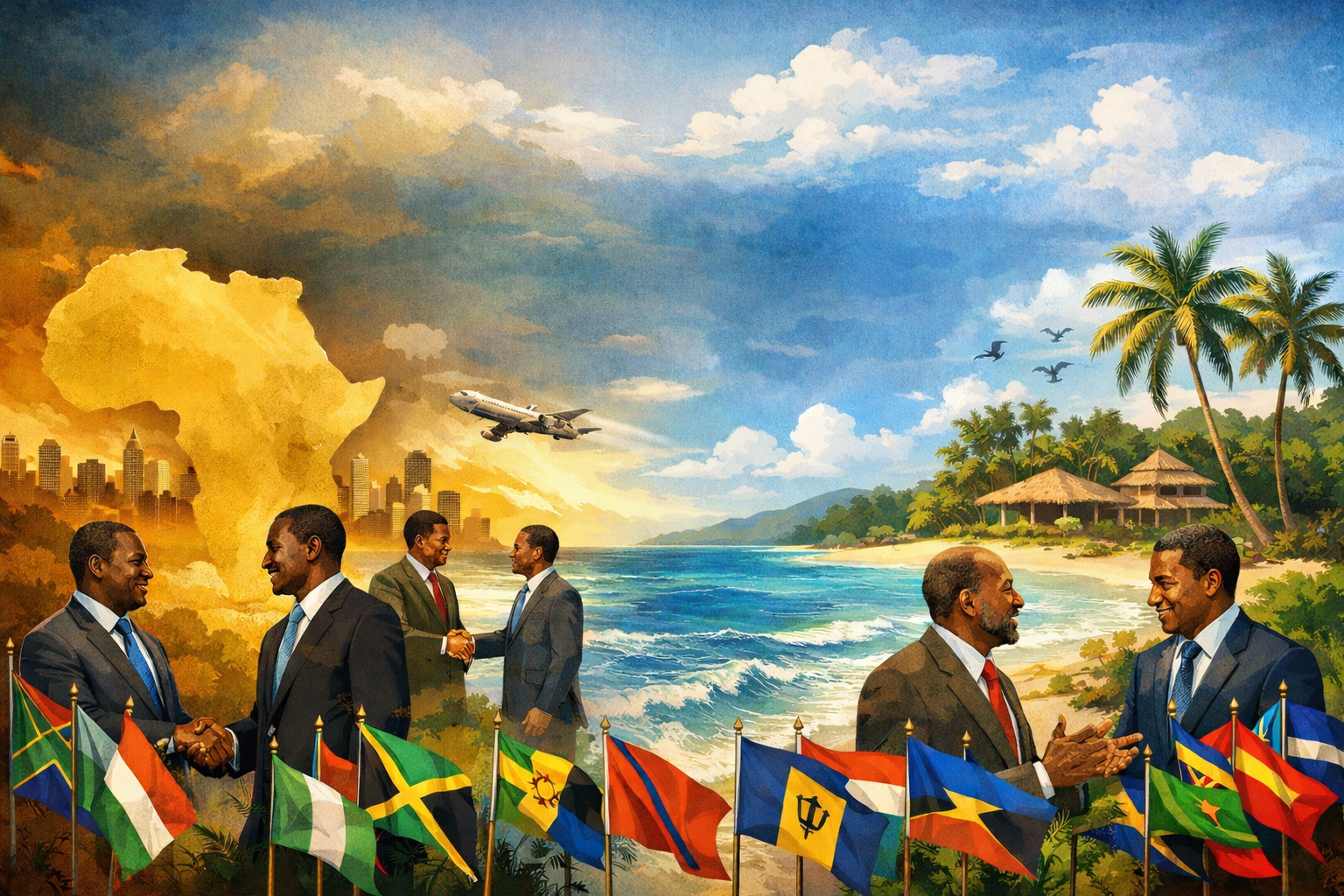

Political South-South Cooperation refers to the collaboration and engagement among states of the Global South in political matters, such as diplomacy, international relations, governance, policy formulation, and the promotion of common interests in the global arena1UNOSSC, n.d.. It is often aimed at creating a collective voice among Global South states in international fora, advocating for more equitable global governance, and enhancing the influence of developing states in the decision-making process.
Some of the key elements of Political South-South Cooperation include:
- Diplomatic engagement: Establishing and maintaining strong diplomatic ties among Global South states, often through direct bilateral relations, regional organizations, and multilateral institutions2G77, n.d..
- Advocacy for shared goals and interests: Actively promoting common political values and objectives, such as poverty alleviation, climate action, and the strengthening of multilateralism3Bandung Conference, 1955.
- Alliance-building: Forming strategic partnerships and alliances among Global South states, both regionally and globally, to enhance collective bargaining power in international negotiations and to further shared objectives4Non-Aligned Movement, n.d..
- Promotion of democratic institutions and good governance practices: Many South-South initiatives emphasize the importance of strengthening democratic institutions, enhancing transparency, and fostering good governance practices within participating Global South states5UNOSSC, n.d..
The above parameters considered, this note delves into the intricacies of Political South-South Cooperation in the context of the African Union (AU) and the Caribbean Community (CARICOM) relations. The discussion primarily focuses on the shared political interests, values, and aspirations of their member states, recognizing patterns of collaboration and intergovernmental dialogue to tackle common challenges and pursue joint objectives. Various dimensions of cooperation, such as bilateral, diplomacy, multilateral diplomacy, peace and security, and regional integration strategies, are explored to synthesize a comprehensive understanding of the evolving political partnership between these two regional organizations.
Diplomatic Engagement in AU-CARICOM Relations
This section explores diplomatic engagements between the African Union (AU) and the Caribbean Community (CARICOM) for the period 2002-2022. With shared cultural, historical, and political backgrounds, the AU and CARICOM are well-positioned to foster strong diplomatic engagements that could contribute significantly to promoting mutual development between the two regions.
The section begins by providing an overview of the key milestones and developments in the history of AU-CARICOM relations, emphasizing the timeline of events that have shaped this partnership since its inception. Following this, the following will examine the various diplomatic channels and platforms that enable effective communication and collaboration between the two organizations, which include bilateral meetings, joint initiatives, and regular dialogues.
Table 1 presents a summary of diplomatic engagements between various CARICOM (Caribbean Community) countries and AU (African Union) countries. The list of CARICOM countries is provided along the left column, from Antigua and Barbuda to Trinidad and Tobago. The corresponding right column indicates AU countries with which each CARICOM country has diplomatic relations. The table aims to show the existing connections between these two regional organizations, highlighting the potential for stronger collaboration and partnership.
Table 1: Diplomatic Engagements between CARICOM and AU countries
| CARICOM Country | AU Countries with which CARICOM Country has Diplomatic Relations | Notable Outcomes |
| Antigua and Barbuda | Algeria, Botswana, Cape Verde, Egypt, Ethiopia, Ghana, Kenya, Libya, Morocco, Rwanda | AU-CARICOM Summit |
| The Bahamas | Cameroon,Cape Verde, Côte D’Ivoire, Eswatini, Gambia, Ghana, Lesotho, Malawi, Maldives, Morocco, Mozambique, Namibia, Nigeria, Rwanda, Seychelles, Sierra Leone, South Africa, Zambia, Zimbabwe | AU-CARICOM Summit |
| Barbados | Algeria, Angola, Botswana, Cabo Verde, Egypt, Ghana, Kenya, Lesotho, Mali, Mauritius, Morocco, Namibia, Niger, Nigeria, Rwanda, Senegal, South Africa, Tanzania, Zambia | AU-CARICOM Summit Barbados and Ghana signed an agreement |
| Belize | Algeria, Angola, Botswana, Egypt, Ghana, Kenya, Morocco, Mozambique, Nigeria, Rwanda, Seychelles, Sierra Leone, South Africa, Tunisia, Zambia | AU-CARICOM Summit |
| Dominica | Algeria, Botswana, Cape Verde, Djibouti, Egypt, Eritrea, Ethiopia, Gabon, Gambia, Ghana, Ivory Coast, Kenya, Libya, Mauritius, Morocco, Nigeria, Rwanda, Senegal, Seychelles, South Africa, Sudan, Uganda | AU-CARICOM Summit |
| Grenada | Republic of Congo | AU-CARICOM Summit |
| Guyana | Algeria, Angola, Botswana, Burkina Faso, Cape Verde, Egypt, Eswatini, Ethiopia, Gambia, Ghana, Guinea, Kenya, Lesotho, Liberia, Libya, Mauritius, Mozambique, Namibia, Niger, Nigeria, Rwanda, Senegal, Seychelles, Sierra Leone, South Africa, Tanzania, Uganda, Zambia, Zimbabwe | AU-CARICOM Summit Guyana and Ghana signed a Memorandum of Understanding (MoU) to strengthen their relationship, particularly in the petroleum sector. The MoU aims to facilitate knowledge exchange and cooperation between both countries in the area of oil and gas, as well as promote collaboration on technical assistance, training, and capacity-building efforts. The MoU also includes provisions for visa-free travel between the two countries, which is expected to enhance mutual understanding, cultural exchanges, tourism, and business ties. |
| Haiti | Benin, Gabon, Burundi, Democratic Republic of Congo, Côte D’Ivoire, Liberia, Libya, Mauritius, Mozambique, Niger, Nigeria, Rwanda, Senegal, Seychelles, South Africa | AU-CARICOM Summit |
| Jamaica | Algeria, Angola, Benin, Botswana, Burkina Faso, Cameroon, Egypt, Equatorial Guinea, Eswatini, Ethiopia, Gabon, Gambia, Ghana, Guinea, Kenya, Lesotho, Liberia, Libya, Mali, Mauritius, Morocco, Mozambique, Namibia, Niger, Nigeria, Republic of Congo, Rwanda, Senegal, Sierra Leone, South Africa, Sudan, Tanzania, Togo, Uganda, Zambia, Zimbabwe | AU-CARICOM Summit |
| Montserrat | AU-CARICOM Summit | |
| Saint Kitts and Nevis | Algeria, Benin, Botswana, Burkina Faso, Cameroon, Djibouti, Egypt, Eswatini, Ethiopia, Gabon, Gambia, Ghana, Kenya, Mauritius, Morocco, Mozambique, Rwanda, Senegal, South Africa, Sudan, Togo, Uganda, Zimbabwe | AU-CARICOM Summit |
| Saint Lucia | Algeria, Cape Verde, Egypt, Ethiopia, Gambia, Kenya, Libya, Morocco, Namibia, Rwanda, Seychelles, South Africa | AU-CARICOM Summit |
| Saint Vincent & the Grenadines | Algeria, Angola, Botswana, Burkina Faso, Burundi, Cabo Verde, Comoros, Djibouti, Egypt, Ethiopia, Gambia, Ghana, Ivory Coast, Kenya, Liberia, Libya, Mali, Mauritius, Morocco, Namibia, Niger, Rwanda, Senegal, Seychelles, South Africa, Tunisia, Uganda | AU-CARICOM Summit |
| Suriname | Algeria, Angola, Botswana, Cape Verde, Djibouti, Egypt, Equatorial Guinea, Eswatini, Gambia, Ghana, Guinea, Ivory Coast, Kenya, Libya, Maldives, Mali, Mauritius, Morocco, Mozambique, Namibia, Nigeria, North Macedonia, Rwanda, Senegal, Sierra Leone, Somalia, South Africa, Sudan, Tanzania, Togo, Zambia, Zimbabwe | AU-CARICOM Summit |
| Trinidad & Tobago | Angola, Botswana, Cameroon, Ghana, Guinea, Ivory Coast, Lesotho, Liberia, Malawi, Mauritius, Mozambique, Namibia, Nigeria, Senegal, Sierra Leone, South Africa, Zambia, Zimbabwe | AU-CARICOM Summit |
A closer examination of Table 1 reveals that while diplomatic relations between CARICOM and African Union member states are extensive in breadth, they are thin in depth and uneven in substance.
- Diplomatic Density Without Strategic Differentiation: Most CARICOM states maintain diplomatic relations with a large number of AU countries, often exceeding 15–20 partners. However, this density appears non-selective. There is little evidence that diplomatic outreach is guided by: trade complementarities, labour market needs, energy security concerns, orsector-specific cooperation (e.g. agriculture, health, logistics, or education).
Instead, diplomatic ties appear largely uniform, suggesting a model of symbolic recognition rather than strategic engagement. This creates a situation where having relations substitutes for using relations.
- Recurrent AU Partners and the Politics of Visibility: Countries such as Algeria, Egypt, Ghana, Morocco, Rwanda, and South Africa recur frequently across CARICOM states. This pattern suggests: reliance on regionally visible or diplomatically active African states, rather than a deliberate attempt to diversify partnerships across Africa’s sub-regions or economic profiles.
Notably, smaller or less globally visible African states (e.g. Eritrea, Comoros, Burundi, Central African Republic) appear sporadically or not at all. This points to a visibility bias, where diplomacy follows prominence rather than mutual developmental need.
- Summit-Driven Diplomacy and the Problem of Event Substitution: Almost every CARICOM–AU linkage listed culminates in the same outcome: participation in the AU–CARICOM Summit. This reveals a structural weakness: summits have become substitutes for sustained bilateral cooperation.
Additionally, it emerges that outside of a small number of exceptions (e.g. the Guyana–Ghana MoU in petroleum cooperation and visa-free travel), there is: no consistent evidence of follow-up mechanisms, no publicly articulated sectoral pipelines, and no institutional reporting on post-summit implementation.
Diplomacy, in this context, appears event-centred rather than process-centred.
- The Absence of Material Outputs: Despite the extensive diplomatic web, there is a striking lack of: trade agreements, labour mobility frameworks, joint infrastructure projects, or co-financed development initiatives. This gap indicates that diplomatic relations are decoupled from economic and demographic realities, particularly given: Africa’s surplus labour and youthful population, and the Caribbean’s ageing population and labour shortages in health, construction, agriculture, and care services.
The table therefore exposes a fundamental contradiction: high diplomatic engagement alongside low material integration.
- Institutional Insight: Taken together, the data suggests that CARICOM–AU relations currently operate at the level of political signalling rather than institutional coordination. Diplomatic relations exist, but they are not embedded within: enforceable policy frameworks, intergovernmental implementation units, or measurable development objectives.
This reflects a broader pattern of what may be described as ceremonial intensification without material deepening, a condition in which political visibility increases while practical cooperation stagnates.
While Table 1 demonstrates that a broad diplomatic architecture exists between CARICOM and African Union member states, the evidence suggests that these engagements remain largely symbolic and under-utilised. Diplomatic relations have not yet translated into sustained economic cooperation, labour mobility arrangements, or development outcomes. The challenge facing both regions is therefore not the absence of diplomatic ties, but the absence of institutional mechanisms that convert diplomacy into delivery.
Advocacy for Shared Goals and Interests, Collective Bargaining and Promotion of Good Governance
The member states of the African Union (AU) and the Caribbean Community (CARICOM) are integral constituents of the Organization of African, Caribbean, and Pacific States (OACPS), formerly known as the ACP-EU Partnership. The Cotonou Agreement, which supplanted the Lomé agreements, enshrined structured political dialogue as a core pillar of cooperation, recognising that sustainable development and poverty alleviation are inseparable from political stability, human rights protection, and good governance. This marked a shift towards a more holistic and dialogue-based model of international cooperation, reflecting growing international consensus that development challenges cannot be addressed in purely economic terms.
However, while the Cotonou framework elevated political dialogue in principle, it largely confined advocacy for shared objectives to the domain of soft politics, with limited translation into coordinated economic or strategic action among OACPS members themselves. Political dialogue, though institutionalised, was not accompanied by robust mechanisms to foster collective bargaining or sustained South–South policy coordination between African and Caribbean states.
This limitation becomes particularly evident in the context of economic negotiations. As Pichon (2021) observes, Economic Partnership Agreements (EPAs) have been negotiated across three broad regional configurations—the Caribbean, the Pacific, and five distinct African groupings—each governed by differentiated trade provisions, many of which remain partially or wholly unimplemented. This fragmented negotiating architecture has prompted concerns among scholars that the Cotonou framework, rather than reinforcing cohesion within the ACP grouping, has contributed to its functional disaggregation.
Such differentiation risks weakening the potential for unified ACP—or more specifically AU–CARICOM—collective bargaining vis-à-vis external partners. By encouraging region-specific negotiations and asymmetrical obligations, the Cotonou arrangements do little to incentivise meaningful Political South–South cooperation, either through coordinated advocacy for shared development goals or through the articulation of common negotiating positions. Consequently, while AU and CARICOM states coexist within the same institutional umbrella, the structural design of the post-Lomé trade regime has limited their capacity to leverage that shared membership into tangible political or economic solidarity.